Stock Story: Crown Castle

Rates are up, infrastructure and bonds are down. Which is a better bet from here?
Higher yields have increased the prospective returns for bonds and infrastructure equities. We prefer the real growth that listed infrastructure has to offer. Crown Castle (CCI) is a highly predictable free cash-flow-generating business offering a compelling 6.2% yield combined with underlying structural growth.
Crown Castle is a US listed Tower REIT with an irreplaceable set of infrastructure assets
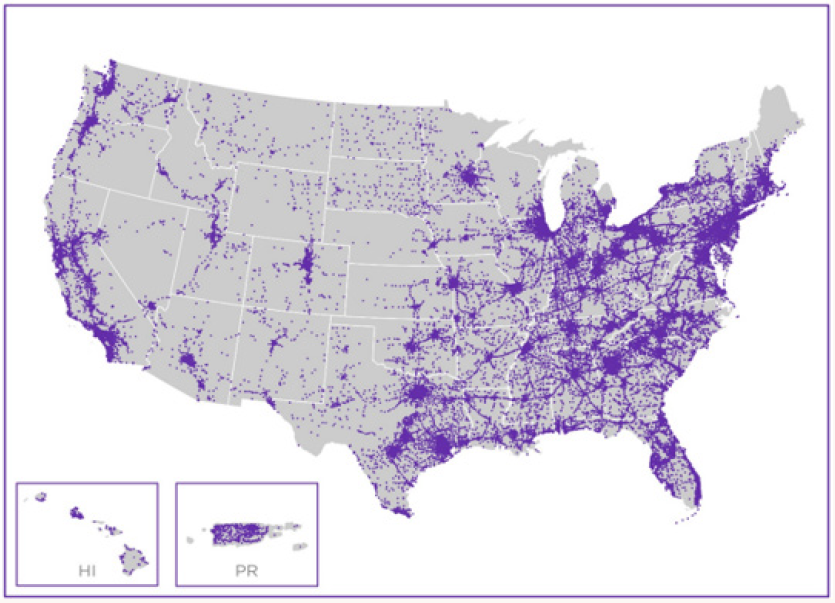
Crown Castle is one of the largest operators of telecommunications infrastructure in the US, where it provides the locations for telecommunication companies to site their active equipment such as antennas. Built or acquired between 1995 and 2013, many of these cell sites a tower or change the location of a tower due to network engineering challenges, permitting and NIMBY-ism. Figure 1 shows CCI’s existing tower footprint across metro areas and busy transport links.
Figure 1: Crown Castle tower asset portfolio overview
Crown Castle operates ~39,700 tower & rooftop sites across the US. The portfolio skews to metro areas compared to peers. Approximately 71% of their towers are located in the top 100 trading areas in the US.
Source: CCI Company Documents
How CCI makes money: A beautifully simple business model
Predictable cash flow streams, high margins and strong operating leverage: towers are the infrastructure sector’s version of the SAAS business model without the potential of disruption from AI.
To keep up with the surge in data use, telcos (tower customers) had no choice but to keep investing in their networks. This pressure began with the launch of the iPhone in 2007, intensified when 4G technology arrived in 2009, and grew again in the mid-2010s as social media apps drove a boom in video streaming. Between 2015 and 2025, mobile data traffic in North America grew by an average of 25% per year, according to Ericsson.
Over time, CCI’s rental income has expanded as they lease out more space on each tower to additional telecom tenants as well as larger, heavier antennas and radio equipment to existing customers to add more capacity in that local area. Additional revenue comes with high incremental margins as the cost to maintain a tower does not increase materially with more customers or equipment. Most costs are highly visible and fixed and include land lease costs, real estate taxes, insurance and site maintenance. Therefore, a high proportion of the extra revenue drops to the bottom line.
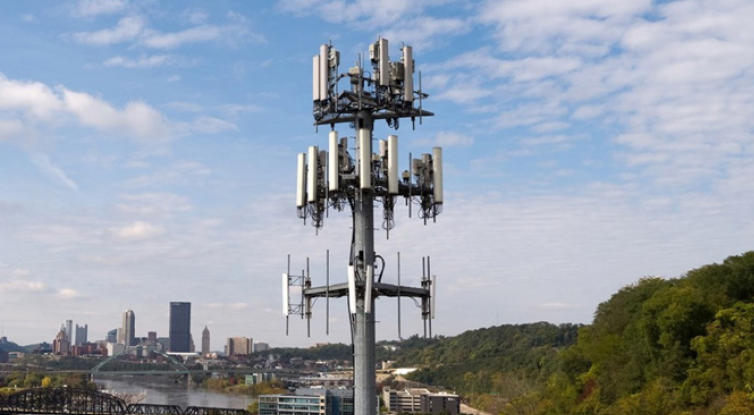
Each tower (see Figure 2) generates on average ~US$95k per year, rents escalate at ~3% under long-term contracts, and costs remain predictable. This is a simple, forecastable business model that compounds over time, underpinned by irreplaceable infrastructure that keeps the world connected.
The market has punished towers over the past 5 years but we see a turning point in the narrative
Calling the bottom for towers over the past 5 years has been a lot like catching a falling knife. While interest rates are the key contributor (to be discussed later), we’d also point to 3 additional reasons for their poor performance and why we see a turn in the narrative on each point.
1. Poor capital allocation: Crown spent much of the last decade piling capex into the untested and unprofitable fibre and small cell business. In 2025 CCI announced the sale of this business line and the replacement of management, returning the business to a higher-quality, free cash-flow-generating pure-play US TowerCo.
2. Customer consolidation and bankruptcy after a period of strong mid-single-digit growth through to 2024: CCI suffered two material churn events due to the merger of T-Mobile and Sprint, followed by the default of a new market entrant, DISH. These churn events were one-off in nature and not representative of a business model in decline. 2026 marks the completion of the bulk of these two revenue loss events. The prospects for growth in 2027 have improved materially.
3. Investor fear of satellites and the Elon Musk effect: The incredible success of the Starlink business and IPO of SpaceX has called into question the longevity of these tower assets by investors who do not specialise in infrastructure. We believe there are limitations in physics (something AI and lower launch costs cannot change) that prevents towers – even in many rural areas – from being disrupted by direct-to-device satellite communications. This is due primarily to the density of traffic delivered to phones during times of peak demand. These physical limitations include free-space path loss, weak upload performance from omnidirectional phone antennas, beam diameter and indoor coverage.
Figure 2: Crown Castle tower asset example
Pictured is one of Crown Castle’s assets with three tenants. Crown Castle owns and manages the passive infrastructure (tower, the land and building under the tower) whereas the customers manage the active equipment (antenna, radios, fibre backhaul, etc.)
Source: CCI Company Documents
Those who have followed the industry closely would have noticed Elon Musk alluding to the possibility of a direct-to-cell satellite service (not to be confused with Starlink’s larger broadband satellite constellation) on par with traditional terrestrial wireless. Since then, telecom executives and radio frequency engineers have come out dismissing the potential for low-earth-orbit satellites to provide high-bandwidth cell service in metro areas directly to a mobile phone. The latest in this saga came in early October, when SpaceX announced that they may build “an advanced terrestrial deployment” to become “a major mobile carrier in the US”. This non-committal announcement caused a +16% 1-day move in CCI’s stock price as the market is speculating that Starlink could become a new customer on CCI’s towers. While we remain sceptical about this, we believe that this helps chip away at the tower disruption narrative.
Rates up, CCI down. Ultimately prospective returns improve from here
On fundamentals, interest rates have a limited impact on the operating cash flows of CCI as their revenues are the telco’s stay-in-business payments for essential services. However, interest rates do have an impact on equity returns in the form of higher borrowing costs as debt is refinanced. CCI has mitigated this with currently 100% fixed-interest-rate debt.
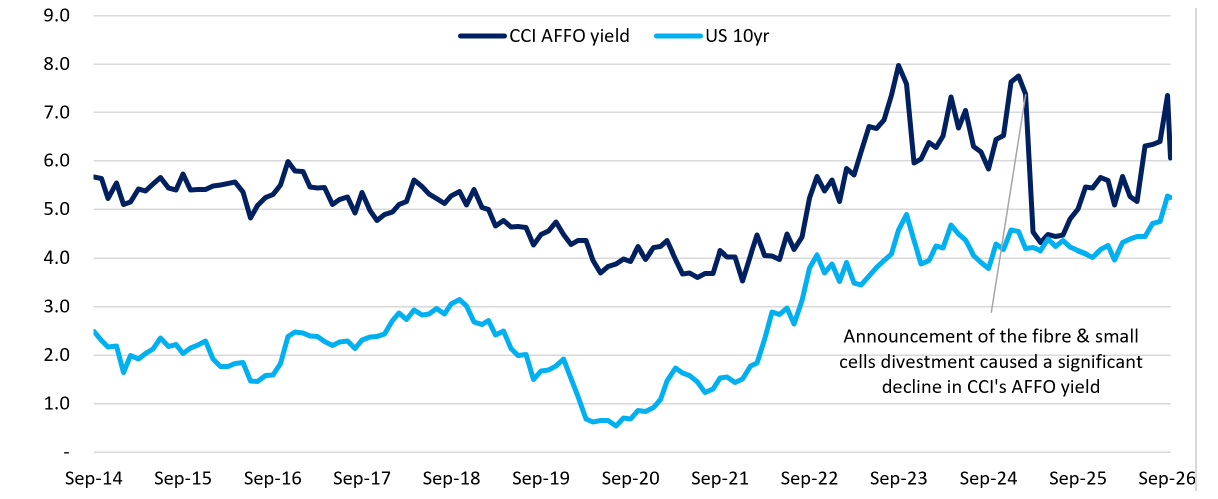
While fundamentals don’t change much, CCI’s stock price is inversely correlated to the US 10-year Treasury yield and it has undoubtedly been a loser as the 10-year bond yield increased from 1.51% at the end of 2021 to 5.24% today. Figure 3 shows how the Adjusted Funds From Operations (AFFO) yield of CCI has traded in lockstep with the 10-year yield because equity returns are viewed as low growth and “bond-like”.
Figure 3: Crown Castle (next 12 months) AFFO and the US 10-year Treasury yield
Higher interest rates are capitalised into CCI’s share price quickly. Shares fell by 15% during the 2Q & 3Q26 quarters primarily because the US 10-year yield increased by almost 1% (97bp), during a period in which CCI raised their FY2026 guidance.
Source: CCI Company Documents
Valuations of more exciting higher-growth companies can defy an increase in the cost of capital for longer periods of time. However, eventually a higher cost of capital environment slows investment and more cyclical business activity, whereas a higher cost of capital is capitalised into CCI’s share price almost instantly, therefore lifting prospective returns. While we cannot predict where interest rates go from here, should we see a downturn in economic activity, interest rates generally move lower and there is generally a defensive rotation in equity markets to companies with greater certainty of cash flows like CCI.
As we move past the headwinds of the past 5 years, the investment proposition is simple
The forecasted 2027 AFFO yield for CCI currently sits at 6.2%. Revenues are expected to grow at least 3% in a business with natural operating leverage. Therefore, our prudent case for shareholder returns (at current interest rate levels) is ~9% p.a. over our investment horizon. While CCI is often compared to high-yield credit as an investment proposition, we believe the differentiator in infrastructure equity is the duration of real growth that compounds over decades. Imagine a future with networks of autonomous vehicles, smart cities or abundant robotics without a high-speed and reliable terrestrial wireless network. Tower infrastructure is the foundation for this future.
Roy Harrison, Investment Analyst
This material has been delivered to you by Magellan Asset Management Limited ABN 31 120 593 946 AFS Licence No. 304 301 trading as Magellan Investment Partners (‘Magellan’) and has been prepared for general information purposes only and must not be construed as investment advice or as an investment recommendation. This material does not take into account your investment objectives, financial situation or particular needs. This material does not constitute an offer or inducement to engage in an investment activity nor does it form part of any offer documentation, offer or invitation to purchase, sell or subscribe for interests in any type of investment product or service. You should obtain and consider the relevant Product Disclosure Statement (‘PDS’) and Target Market Determination (‘TMD’) and consider obtaining professional investment advice tailored to your specific circumstances before making a decision about whether to acquire, or continue to hold, the relevant financial product. A copy of the relevant PDS and TMD relating to a Magellan financial product may be obtained by calling +61 2 9235 4888 or by visiting www.magellaninvestmentpartners.com
Past performance is not necessarily indicative of future results and no person guarantees the future performance of any financial product or service, the amount or timing of any return from it, that asset allocations will be met, that it will be able to implement its investment strategy or that its investment objectives will be achieved. This material may contain ‘forward-looking statements’.
Actual events or results or the actual performance of a Magellan financial product or service may differ materially from those reflected or contemplated in such forward-looking statements. This material may include data, research and other information from third party sources. No guarantee is made that such information is accurate, complete or timely and no warranty is given regarding results obtained from its use. This information is subject to change at any time and no person has any responsibility to update any of the information provided in this material. Statements contained in this material that are not historical facts are based on current expectations, estimates, projections, opinions and beliefs of Magellan or the third party responsible for making those statements (as relevant). Such statements involve known and unknown risks, uncertainties and other factors, and undue reliance should not be placed thereon. No representation or warranty is made with respect to the accuracy or completeness of any of the information contained in this material. Magellan will not be responsible or liable for any losses arising from your use or reliance upon any part of the information contained in this material.
Any third-party trademarks contained herein are the property of their respective owners and Magellan claims no ownership in, nor any affiliation with, such trademarks. Any third-party trademarks contained herein are the property of their respective owners, are used for information purposes and only to identify the company names or brands of their respective owners, and no affiliation, sponsorship or endorsement should be inferred from such use. This material and the information contained within it may not be reproduced, or disclosed, in whole or in part, without the prior written consent of Magellan. (310726-#W16)